
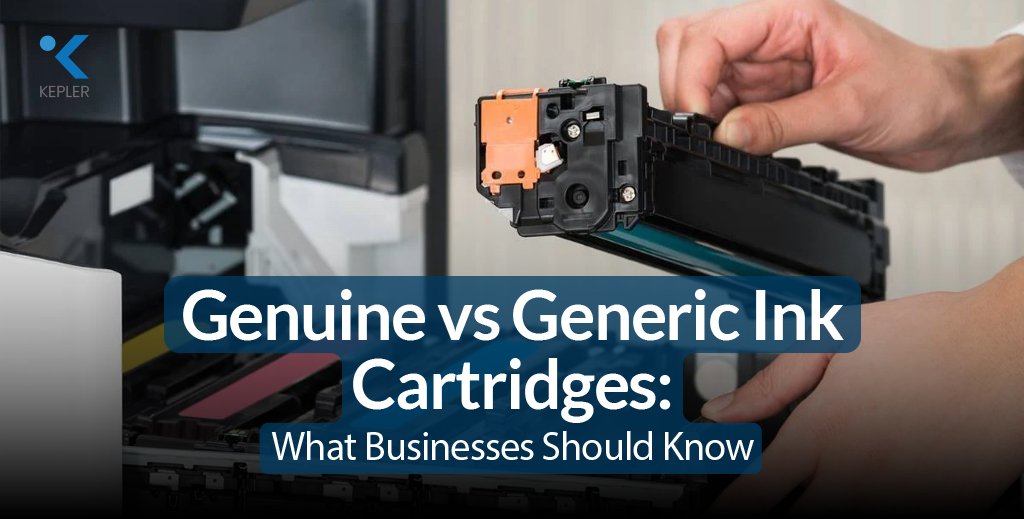
Is the Cheapest Ink Cartridge Really the Most Cost-Effective?
Imagine your business has an important client proposal to print, a large batch of invoices to prepare, or a set of marketing documents that need to be ready before a meeting. You send the files to the printer, but the output doesn’t look right. The colours appear inconsistent, the text is not as sharp as expected, or the printer suddenly displays a cartridge-related error.
Now consider this: Did choosing a cheaper ink cartridge actually save your business money?
For businesses that print thousands of pages, ink cartridges and other printer consumables are not simply another office expense. The choice between generic and genuine ink cartridges can affect print quality, printer reliability, productivity, maintenance requirements, and overall printing costs.
Many businesses assume that a generic cartridge is automatically the more economical option because it costs less to purchase. But the initial price is only one part of the calculation. Businesses should also consider ink yield, compatibility, print consistency, reprints, paper wastage, maintenance, printer downtime, and long-term operating costs.
So, are genuine ink cartridges always the better choice? Can generic ink cartridges provide reliable performance? And how can businesses determine which option is most suitable for their printing requirements?
In this guide, we’ll compare genuine vs generic ink cartridges, explain the key differences between them, and explore how cartridge choice can affect print quality, compatibility, reliability, and the actual cost of business printing.
What Are Genuine vs Generic Ink Cartridges?
Before comparing genuine and generic ink cartridges, it is important to understand what these terms actually mean.
Genuine ink cartridges, also known as original or OEM ink cartridges, are manufactured by the same brand that produces the printer. These cartridges are designed specifically for compatible printer models and are developed to work with the printer’s intended ink delivery system.
For example, businesses using an Epson inkjet printer may choose compatible Epson ink cartridges designed for that particular printer model. The ink formulation, cartridge design, and printer compatibility are developed to support predictable performance and consistent print output.
Genuine ink cartridges are generally tested for compatibility and performance with the printer models they are intended for. This can make them a preferred option for businesses where reliable printing and consistent results are important.
Generic ink cartridges, also known as compatible ink cartridges, are manufactured by third-party companies rather than the original printer manufacturer. They are designed to work with specific printer models and are usually available at a lower upfront price.
The quality of generic ink cartridges can vary significantly between manufacturers. Some compatible products may provide satisfactory performance, while lower-quality alternatives may produce inconsistent results or experience compatibility issues.
It is also important to distinguish generic ink cartridges from refilled and remanufactured cartridges. A refilled cartridge is typically an existing cartridge that has been filled with ink again, while a remanufactured cartridge generally involves cleaning, inspecting, and replacing certain components before being refilled.
Therefore, businesses should not assume that all non-OEM options are identical. Compatibility does not automatically guarantee the same level of quality, reliability, or performance.
Genuine vs Generic Ink Cartridges: What’s the Difference?
At first glance, genuine and generic ink cartridges may appear to perform exactly the same function. Both are designed to deliver ink to a printer, but businesses may notice differences in areas such as compatibility, print quality, ink yield, colour consistency, and long-term performance.
| Factor | Genuine Ink Cartridges | Generic Ink Cartridges |
| Compatibility | Designed specifically for compatible printer models | Designed to be compatible with specific printer models |
| Print Quality | Generally more predictable | Can vary depending on manufacturer and product quality |
| Colour Consistency | Usually consistent | May vary between products or batches |
| Ink Yield | Generally more predictable | May vary depending on product quality |
| Printer Recognition | Typically reliable | May occasionally experience compatibility issues |
| Upfront Cost | Usually higher | Usually lower |
| Long-Term Performance | More predictable | Depends on quality, compatibility, and manufacturer |
The most important point is that businesses should not evaluate genuine vs generic ink cartridges based solely on their purchase price.
A cartridge that costs less initially may not necessarily provide the lowest cost per printed page. Similarly, a more expensive genuine ink cartridge may offer benefits that are particularly valuable to businesses that prioritise consistent output and reliable printer operation.
The right choice depends on the business’s printing volume, quality requirements, printer type, budget, and tolerance for potential interruptions.
Print Quality: Does Ink Cartridge Choice Make a Difference?
Think about the last time you received a poorly printed business document. Perhaps the text looked slightly blurred, colours appeared different from the original design, or an important image lacked detail.
For personal printing, this may be a minor inconvenience. For a business, however, poor print quality can affect how customers, clients, and partners perceive the organisation.
The quality of printer ink cartridges can influence several aspects of printed output, including:
- Text sharpness
- Colour accuracy
- Colour consistency
- Image quality
- Ink density
- Print uniformity
- Overall visual presentation
Genuine ink cartridges are developed specifically for compatible printer models, which generally makes their performance more predictable. For example, businesses using Epson printers for documents or colour-sensitive applications may choose compatible Epson ink cartridges to support consistent output.
Generic ink cartridges can also produce good results, particularly when they are manufactured by reputable companies and designed correctly for the intended printer. However, performance can vary depending on the manufacturer, ink formulation, quality control, and printer compatibility.
The difference may be more noticeable for businesses that regularly produce customer-facing or presentation-quality materials.
Marketing agencies may need consistent brand colours. Retail businesses may print promotional materials. Creative companies may require accurate colour reproduction. Professional service providers may print client proposals and presentations. Photography-related businesses may have even more demanding requirements for colour and image quality.
A slightly imperfect internal document may not have a significant impact. However, a poorly printed client proposal, brochure, or presentation can create a negative impression.
Ink Cartridge Compatibility and Printer Reliability: What Should Businesses Consider?
An ink cartridge is not simply a container of ink. Modern printers may use chips, sensors, and other technologies to communicate cartridge information to the printer and monitor ink levels.
Businesses should therefore consider:
- Cartridge recognition
- Ink flow
- Printer communication
- Firmware compatibility
- Potential error messages
- Installation requirements
- Printer-specific compatibility
Genuine ink cartridges are designed specifically for compatible printers, which can make their performance more predictable.
With generic ink cartridges, the experience can depend heavily on the manufacturer and the quality standards followed during production. A well-manufactured compatible cartridge may perform effectively, while a poorly manufactured product may create issues during installation or operation.
However, it would be inaccurate to claim that all generic ink cartridges cause printer problems. Many third-party products are designed to work with specific printer models and can provide satisfactory results.
The key consideration is to choose the right product from a reliable source and confirm that it is compatible with the exact printer model.
For businesses that rely on printers throughout the working day, even a small compatibility issue can interrupt workflows. If employees cannot print invoices, contracts, reports, or customer documents when needed, the impact may extend beyond the cost of the ink cartridge itself.
Ink Yield and Actual Printing Cost: Is a Cheaper Ink Cartridge Really Cheaper?
Here’s an important question to ask before purchasing any ink cartridge:
Are you comparing the price of the cartridge—or the actual cost of producing each printed page?
These are not always the same thing.
When comparing genuine and generic ink cartridges, businesses should consider:
- Ink yield
- Cost per page
- Cartridge replacement frequency
- Ink wastage
- Reprints
- Paper wastage
- Maintenance requirements
- Employee time spent resolving printing issues
A generic ink cartridge may have a lower purchase price, but if its actual yield is lower or it produces inconsistent output that requires reprinting, the initial saving may not represent the true cost advantage.
Similarly, a cartridge that needs to be replaced more frequently can increase purchasing and administrative work. If printing problems also result in additional cleaning, troubleshooting, or technical support, the overall cost may increase further.
This is why businesses should evaluate the total cost of ownership rather than focusing only on the purchase price.
Instead of asking:
“Which ink cartridge is cheaper?”
Businesses should ask:
“Which ink cartridge provides the best balance between cost, quality, reliability, and productivity?”
This approach helps businesses make purchasing decisions based on actual printing requirements rather than simply choosing the lowest-priced option.
Can Generic Ink Cartridges Affect Printer Performance?
The answer is: they can, but it depends on the quality of the product and how well it is matched to the printer.
Some lower-quality generic ink cartridges may potentially contribute to issues such as:
- Inconsistent ink flow
- Clogging
- Leakage
- Poor print quality
- Increased cleaning cycles
- Cartridge recognition problems
For inkjet printers, the quality of the ink formulation can be particularly important. If an ink cartridge does not perform consistently, businesses may experience changes in print quality or require additional printer cleaning.
However, it would be inaccurate to suggest that every generic ink cartridge performs poorly. Some third-party manufacturers produce compatible ink cartridges that can deliver satisfactory results when they are properly designed and manufactured.
The important factor is product quality and compatibility.
Businesses considering generic ink cartridges should evaluate the manufacturer’s reputation, product specifications, compatibility information, supplier support, and customer feedback rather than selecting a product based solely on the lowest price.
Genuine vs Generic Ink Cartridges: Which Is Better for Different Businesses?
There is no single answer that applies to every organisation. The most suitable ink cartridge depends on what a business prints, how frequently it prints, and how important uninterrupted printer operation is to its daily activities.
Corporate Offices
Corporate offices may print contracts, reports, invoices, presentations, and internal documents every day. Businesses that prioritise predictable performance and minimal interruptions may prefer genuine ink cartridges, particularly for important or customer-facing documents.
Retail Businesses
Retail businesses often rely on printers for invoices, reports, promotional documents, and other operational materials. In these environments, reliability and cartridge availability may be more important than achieving the lowest possible purchase price.
Healthcare Organisations
Healthcare organisations require clear and reliable documentation for administrative and operational purposes. Consistent printing can be particularly important when employees depend on printed information as part of their daily workflows.
Educational Institutions
Schools, colleges, and training organisations may print examination materials, certificates, reports, worksheets, and administrative documents. Their cartridge requirements can vary depending on whether they need high-volume internal printing or higher-quality presentation materials.
Marketing and Creative Businesses
Marketing and creative businesses may have greater sensitivity to colour accuracy and visual presentation. When printed materials represent a brand or are delivered to clients, consistent output can be an important consideration when selecting ink cartridges.
Photography and Creative Printing
Businesses involved in photographic or creative printing may have demanding quality requirements. In these applications, using compatible printer technology, suitable media, and reliable ink cartridges can help support consistent results.
Ultimately, the best ink cartridge is the one that matches the business’s specific application, quality expectations, printing volume, and reliability requirements.
When Should Businesses Choose Genuine Ink Cartridges?
Genuine ink cartridges may be particularly suitable when:
- The business has high printing volumes.
- Printer downtime can disrupt important operations.
- Consistent colour output is important.
- Documents are regularly provided to customers or clients.
- Print quality directly affects brand presentation.
- The printer is under warranty, and the business wants to follow manufacturer recommendations.
- The organisation uses specialised or expensive printing equipment.
- Predictable performance is more important than the lowest initial purchase price.
That said, businesses with less demanding requirements may choose to evaluate reputable compatible ink cartridges. For internal drafts, test prints, or applications where the highest level of print quality is not essential, a suitable generic option may be worth considering.
The important point is to make the decision based on business requirements rather than price alone.
How to Choose the Right Ink Cartridge for Your Business
Before purchasing ink cartridges, businesses can use the following checklist:
1. Check Printer Compatibility
Always confirm that the ink cartridge is designed for the exact printer model. Even cartridges that look similar may not be suitable for every printer.
2. Consider Monthly Print Volume
A business printing a few pages each week has different requirements from one printing thousands of pages every month.
3. Compare Ink Yield
Look beyond the cartridge price and consider how many pages the product is expected to produce.
4. Calculate Cost Per Page
Comparing the estimated cost per printed page can provide a more meaningful picture of value than comparing cartridge prices alone.
5. Identify Your Print Quality Requirements
Determine whether you primarily print internal documents or customer-facing materials where colour accuracy and print quality are more important.
6. Evaluate Cartridge Reliability
Consider the potential impact of inconsistent output, frequent replacement, and printer interruptions.
7. Choose a Reliable Supplier
A reputable printer cartridge supplier can provide product guidance, compatibility information, and after-sales support.
8. Check Product Availability
For businesses that print regularly, consistent access to replacement ink cartridges is important.
9. Consider Maintenance Requirements
Think about whether the cartridge choice could affect printer cleaning, servicing, or other maintenance needs.
10. Look at Long-Term Operating Costs
Finally, consider the overall cost of printing rather than focusing only on the initial cartridge purchase.
How Businesses Can Reduce Ink Cartridge Costs
Choosing between genuine and generic ink cartridges is only one part of managing printing expenses. Businesses can also reduce costs by improving their everyday printing practices.
Use duplex printing: Printing on both sides of the paper can reduce paper consumption for suitable documents.
Avoid unnecessary colour printing: Use black-and-white printing for internal documents when colour is not required.
Use draft mode when appropriate: Internal documents and test prints may not require the highest print-quality settings.
Compare ink yield: An ink cartridge with a higher yield may offer better value depending on the business’s printing volume.
Monitor printing habits: Reviewing what employees print can help identify unnecessary or inefficient printing.
Use suitable paper: The right paper can help achieve better output and prevent unnecessary reprints.
Maintain printers regularly: Proper maintenance can help support consistent performance and extend equipment life.
Purchase from reliable suppliers: Working with dependable printer cartridge suppliers can help businesses source suitable products and reduce the risk of purchasing incompatible or unreliable ink cartridges.
The objective should not simply be to spend less on ink cartridges. It should be to reduce the overall cost of producing the printed materials the business actually needs.
Frequently Asked Questions
1. Are genuine ink cartridges better than generic ink cartridges?
Genuine ink cartridges are specifically developed for compatible printers and generally offer predictable performance and print quality. However, reputable generic ink cartridges can also work effectively, so businesses should evaluate quality, compatibility, and long-term value before deciding.
2. Are generic ink cartridges safe to use?
Generic ink cartridges can be suitable for some businesses when they are manufactured to appropriate quality standards and are fully compatible with the printer. However, performance can vary between manufacturers, so businesses should choose products from reliable sources.
3. Why are genuine ink cartridges more expensive?
Genuine ink cartridges are developed and tested by the original printer manufacturer for specific devices and applications. Their price may reflect factors such as research, development, testing, quality control, and manufacturer support.
4. Do generic ink cartridges affect print quality?
They can, depending on the quality of the ink cartridge and the printer they are used with. Some generic ink cartridges may provide satisfactory results, while lower-quality products can produce inconsistent colours, reduced sharpness, or uneven output.
5. Can generic ink cartridges damage a printer?
Not all generic ink cartridges cause printer damage, and many are designed to work with compatible devices. However, poor-quality products may potentially contribute to issues such as leakage, clogging, or inconsistent performance, which is why product quality and compatibility are important.
6. Are genuine ink cartridges more cost-effective in the long term?
Not necessarily for every business, but genuine ink cartridges can provide predictable performance, ink yield, and compatibility. Businesses should compare the total cost of printing, including reprints, maintenance, downtime, and cartridge replacement, rather than looking only at the initial purchase price.
7. How can businesses reduce ink cartridge costs?
Businesses can reduce printing expenses by monitoring print usage, using duplex printing, limiting unnecessary colour printing, selecting appropriate ink-yield cartridges, maintaining printers, and purchasing suitable consumables from reliable suppliers.
8. How do I choose the right ink cartridge for my printer?
Start by checking the exact printer model and selecting a compatible ink cartridge. Then consider your print volume, required quality, ink yield, cost per page, reliability requirements, and the reputation of the supplier.
Conclusion
Choosing between genuine and generic ink cartridges is ultimately about more than comparing two prices. The right decision depends on compatibility, print quality, ink yield, reliability, maintenance requirements, and the total cost of ownership.
For some businesses, genuine ink cartridges may provide the predictable performance and consistency needed for high-volume or customer-facing printing. For others, reputable compatible ink cartridges may be a practical option for less demanding applications when cost is a major consideration.
The most important thing is to look beyond the initial purchase price. An ink cartridge that costs less upfront may not always deliver the lowest overall printing cost if it results in more frequent replacements, reprints, maintenance, or interruptions. Similarly, paying more for a genuine ink cartridge may not be necessary for every type of internal or low-priority printing.
Businesses should therefore assess their own printing requirements before making a decision. By considering ink yield, printer compatibility, print quality, reliability, maintenance, and long-term operating costs, organisations can choose ink cartridges that provide the right balance of value and performance.
If you’re looking for reliable ink cartridges, printer consumables, and printing solutions, Kepler Tech LLC, a genuine printer consumable supplier in Dubai and across the UAE, provides ink cartridges and other printer consumables to support businesses with different printing requirements.